


感染后肠易激综合征(PI-IBS), 是肠易激综合征(IBS)的重要类型和研究热点[1]。PI-IBS的发病机制目前尚不十分明确,报道表明肠道感染引起的黏膜炎症反应和免疫功能激活可能是PI-IBS发病的重要因素[2⇓-4]。微RNA(miR)-142-3p是一种在结直肠等多种组织器官中高表达的miRNA,对炎症反应具有重要的调控作用。我们对miR测序数据进行分析时发现,表达差异显著的miR-142-3p可能可以作为PI-IBS的生物学标志物。前期临床实验表明,与正常人群的样品相比,PI-IBS患者样品中miR-142-3p水平明显下调,提示miR-142-3p与PI-IBS发生发展有密切关系。本研究拟进一步在动物实验方面探讨miR-142-3p在PI-IBS中的表达及意义,阐明miR-142-3p调控PI-IBS发生发展的分子机制,为PI-IBS的临床治疗提供理论依据和治疗手段。
材料与方法
一、实验材料与试剂
miR-142-3p、高迁移率族蛋白B1(HMGB1)和Toll样受体4(TLR4)引物(北京擎科生物科技有限公司),HMGB1小干扰RNA(siRNA)及阴性对照(广州艾基生物技术有限公司),脂多糖(LPS)、胃蛋白酶(美国 Sigma 公司),磷酸盐缓冲液(PBS)(上海碧云天生物技术有限公司), 原代肠上皮细胞(武汉普诺赛生命科技有限公司),TRIzol 试剂盒[天根生化科技(北京)有限公司],反转录试剂盒、实时荧光定量PCR试剂盒(南京诺唯赞生物科技股份有限公司),转染试剂(深圳市达科为生物技术股份有限公司)。
二、 PI-IBS大鼠模型建立
1. 实验动物
10只SD雄性大鼠由深圳市人民医院动物中心提供,鼠龄6~7周,体质量23~26 g,所有大鼠饲养在恒温、恒湿的清洁级动物房,光线调整为12 h日/夜循环。采用旋毛虫感染建立PI-IBS大鼠模型,采用旋毛虫造模过程如下:将旋毛虫保种大鼠乙醚麻醉后,颈椎脱臼处死,剔取四肢及膈肌肌肉。将肌肉尽量剪碎后置于500 mL含有2.5%胃蛋白酶和0.5%盐酸的消化液中,置于37 ℃水浴消化 12~20 h。反复将消化后混合液经 200 目滤布过滤收集旋毛虫幼虫。将滤液收集 500 r/min,10 min离心,弃上清,重悬于pH为7.2~7.4的PBS,计数调整浓度至1500只/mL。给予每只大鼠0.2 mL含350~400条幼虫的琼脂悬液灌胃,感染后饲养8周,建立PI-IBS模型。本动物实验伦理经深圳市人民医院审批通过(医院伦理编号:LL-KY-2021248)。
2. siRNA 转染实验
原代肠上皮细胞培养于12孔板中。细胞达到60%~80%汇合度时,用jetPRIME®转染试剂开展siRNA转染实验。首先取10 μL的HMGB1 siRNA (10 nmol)及阴性对照 siRNA(10 nmol)添加到100 μL jetPRIME® buffer 中,涡旋10 s,离心10 s,随后向混合液中加入3 μL jetPRIME®转染试剂,涡旋振荡后,室温静置10 min。随后将混悬液滴加到细胞中,置于培养箱继续培养24 h。随后用 LPS (500 ng/mL)及miR-142-3p处理细胞24 h,最后收集肠上皮细胞总RNA。
3. 实时荧光定量PCR检测
检测细胞中miR-142-3p、HMGB1和TLR4 mRNA的表达水平:提取肠上皮细胞细胞总RNA:使用TRIzol试剂盒进行提取。cDNA合成:根据反转录试剂盒说明书操作。miR-142-3p引物序列:正向引物为5′-GGGTGTAGTGTTTCCTAC-3′,反向引物为5′-CAGTGCGTGTCGTGGAG-3′。HMGB1引物序列:正向引物为5′-AGGATCCCAATGCACCCAAGAG-3′,反向引物为5′-TTCGCAACATCACCAATGGACAG-3′。TLR4引物序列:正向引物为5′-GGTCAGACGGTGATAGCGAG-3′,反向引物为5′-GGTCCAGGTTCTTGGTTGAG-3′。qRT-PCR反应:a 反应条件:SYBR Green(2×)5 μL/孔,cDNA 2 μL/ 孔,正反向引物各 0.5 μL/ 孔, ddH2O 2 μL/ 孔;b 反应条件:95 ℃ 5 min,95 ℃ 30 s,60 ℃ 30 s,72 ℃ 30 s(35 次循环)。反应结束后导出数据,采用2-ΔΔCt法计算miR-142-3p、HMGB1和TLR4 mRNA相对表达量。
三、统计学处理
采用SPSS 22.0统计软件。所有实验数据均以 表示,组间比较采用t检验或非参数检验(Mann-Whitney U检验)进行统计分析,P < 0.05表示差异有统计学意义。
结果
一、miR-142-3p在肠上皮细胞中具有抗炎作用
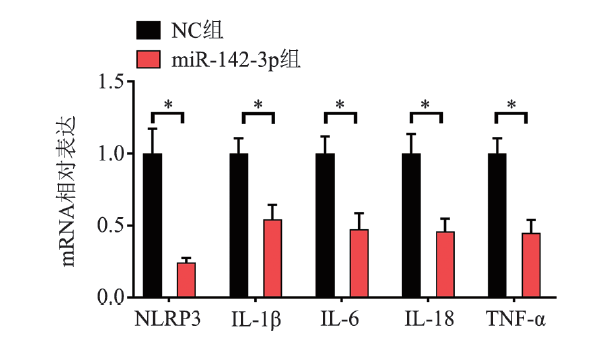
基于miR-142-3p可能与HMGB1-TLR4有潜在的相关性,笔者将在大鼠肠上皮细胞上考察miR-142-3p对HMGB1-TLR4靶基因的作用。炎症基因NOD样受体热蛋白结构域相关蛋白3(NLRP3)、IL-1β、IL-6、IL-18和TNF-α均为HMGB1-TLR4的靶基因。使用LPS刺激后,施加miR-142-3p大大抑制了NLRP3、IL-1β、IL-6、IL-18和TNF-α的表达,这表明miR-142-3p具有抗炎作用(图1)。
二、HMGB1是miR-142-3p的靶基因
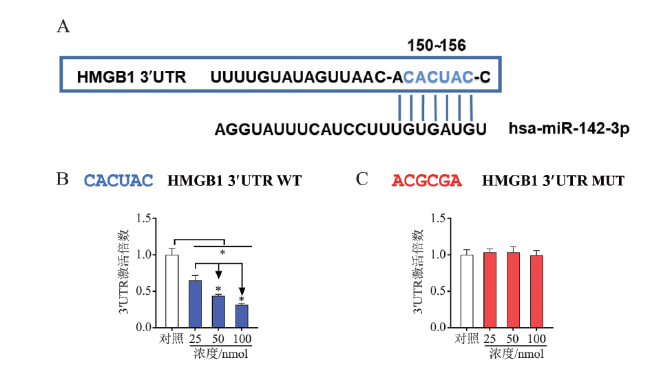
TargetScan预测软件分析表明miR-142-3p在HMGB1的3′UTR上有潜在的结合位点(CACUAC),表明miR-142-3p很有可能调控HMGB1的表达(图2A)。此外,此结合位点在不同种属之间有良好的保守性。miR-142-3p可抑制HMGB1 3′UTR活性,miR-142-3p浓度越高,HMGB1 3′UTR活性越低(F = 10.86,P < 0.05,其中miR-142-3p浓度为50 nmol vs. 25 nmol,P = 0.0102 ;miR-142-3p浓度100 nmol vs. 25 nmol,P = 0.0001)(图2B)。然而当结合位点突变为ACGCGA,miR-142-3p不再调控HMGB1 3′UTR的活性,这表明miR-142-3p调控HMGB1依赖结合位点CACUAC(图2C)。
三、miR-142-3p的抗炎作用依赖于HMGB1


讨论
IBS是一种以复发性腹部不适或疼痛为特征的临床综合征[5-6]。在全球范围内,IBS在男性中的发病率为4%,在女性中为14%,且发病年龄多集中于青壮年,并具有慢性、易复发性等特点,已成为严重影响人们生活质量的主要疾患之一[5-6]。临床研究显示,急性胃肠道感染与IBS发病关系密切,3%~36%的急性肠道感染患者最终会发展为IBS[7]。这种在感染性胃肠炎发生后形成的IBS又称PI-IBS, 是IBS的重要类型和研究热点[4]。PI-IBS的发病机制目前尚不十分明确,有研究认为细胞因子失衡、肠道菌群失调,特别是肠道免疫应答的异常激活是导致PI-IBS发生的关键因素[2⇓-4]。笔者团队既往研究发现PI-IBS患者体内抗炎和促炎细胞因子表达水平存在失衡,其导致低度炎症和免疫激活最终导致了疾病的发生。通过恢复PI-IBS患者体内细胞因子的稳态,可以有效预防和缓解PI-IBS的症状。由于免疫细胞因子和应答网络的复杂性,因此发掘更多调节PI-IBS肠道炎症反应的关键调控因子,对于阐明PI-IBS发病机制和开发新型治疗方法至关重要。
miR是一类内源性非编码小RNA,广泛参与调控细胞的多种生理过程,其异常表达与多种疾病的发生发展密切相关。得益于核酸药物和靶向递送理论和转化研究的迅猛发展,目前已有靶向miR的药物进入到临床研究。miR-142-3p是一种在结直肠等多种组织器官中高表达的miR,对炎症反应具有重要的调控作用。Zhai等[8]研究发现,miR-142-3p通过靶向自噬基因ATG16L1缓解炎症反应。笔者对miRNA靶基因测序数据进行分析发现,表达差异明显的miR-142-3可能可以作为PI-IBS的生物学标志物。HMGB1是一种重要的晚期致炎因子,参与多种组织和细胞的炎症反应和免疫应答。HMGB1可通过与TLR家族受体结合,激活下游信号通路(如核因子κB)和炎症小体(如NLRP3),促进细胞因子的合成和释放,调控免疫应答反应,并参与多种炎症相关疾病的发生[9-10]。HMGB1是一种炎症性蛋白,其广泛分布于各种组织中,并可通过与多种受体结合促进下游信号转导通路的激活,参与炎症性疾病的发生发展。TLR是HMGB1的重要受体,参与多种感染和机体损伤机制。HMGB1可以和TLR4、TLR2受体结合,引起核因子κB信号转导通路上调,促进炎性细胞因子释放,进而引发炎症反应[11-12]。有研究显示,HMGB1在NSAID诱导的PI-IBS中起到重要作用。使用NSAID诱导PI-IBS后,大鼠肠道和血清中的HMGB1表达提高,施加人重组HMGB1蛋白会加重NSAID诱导的肠道损伤,激活核因子κB信号转导通路,促进肠道TNF-α等促炎因子的表达,并同时降低抗炎因子IL-10的水平,而HMGB1抗体则能部分阻断NSAID诱导的肠道损伤[13]。另外,敲除HMGB1的TLR4后,明显缓解HMGB1的加重肠道损伤,证明HMGB1-TLR4信号通路在调控NSAID诱导的PI-IBS中发挥重要作用[13]。
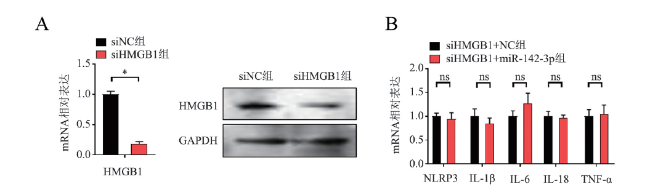
笔者团队前期收集PI-IBS患者及健康人群的样品各10例进行qRT-PCR实验,检测miR-142-3p、HMGB1和 TLR4的表达情况,发现与正常人群相比,PI-IBS患者中miR-142-3p水平明显下调,而HMGB1和TLR4的mRNA水平明显上调。这说明miR-142-3p可能与HMGB1-TLR4有潜在的相关性。之后在大鼠肠上皮细胞中进一步发现miR-142-3p可降低HMGB1-TLR4-核因子κB的靶炎症基因如NLRP3、IL-1β、IL-6、IL-18和TNF-α的表达,并且此抗炎作用依赖于HMGB1。这提示miR-142-3p对HMGB1的调节可能与PI-IBS的发生密切相关。进一步的软件预测结果表明miR-142-3p可以与HMGB1的3′-UTR直接结合。基于以上证据,笔者团队预测 miR-142-3p可能通过抑制晚期促炎因子HMGB1的表达,下调TLR4-NF-κB/NLRP3信号转导通路,从而减轻肠道黏膜的炎症反应和免疫应答,最终防止PI-IBS的发生发展。后续笔者将在动物实验中系统解析miR-142-3p在PI-IBS发生发展中的关键作用,并对其下游炎症反应激活信号转导通路进行探索和验证,以揭示并阐明miR-142-3p调控PI-IBS发生发展的分子机制,为PI-IBS的临床治疗提供理论依据和治疗手段。