


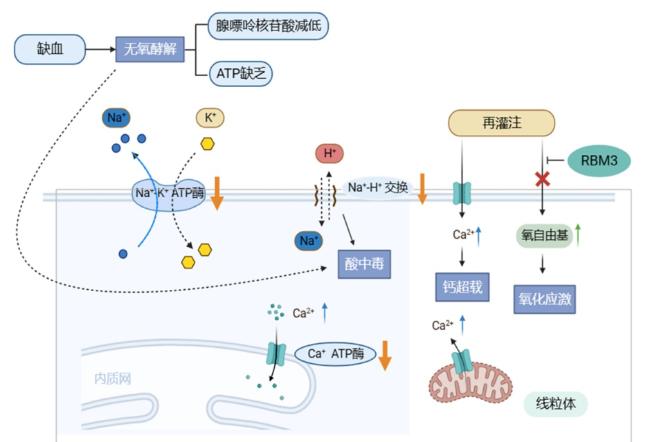
缺血再灌注损伤(IRI)是指组织缺血一段时间后血流恢复时,组织损伤进一步加重、器官功能进一步恶化的综合征[1-2]。其诱导的氧化应激,伴随炎症反应,导致多种疾病的发病率和病死率进一步升高。当机体温度降低时,生物体会产生一组蛋白来适应环境的变化,此类蛋白通常被称为冷休克蛋白。RNA结合基序蛋白3(RBM3)是冷休克蛋白家族中重要的一员,在其N端拥有一个RNA识别结合区域,包含两个核糖核蛋白结构域[3]。据最近的报道,RBM3参与哺乳动物的冷应激过程,这种蛋白质在各种正常细胞、组织和器官中以低水平表达,但在低温的刺激下表达可以上调[4]。在冷应激反应过程中,RBM3可以结合并改变信使核糖核酸(mRNA)的翻译,起到抗氧化和抑制细胞增殖的作用。在一项冬眠棕熊的报道中,增加RBM3的表达有助于冬眠期间棕熊肌肉质量的维持和减轻氧化应激[5]。有研究者发现,低温状态上调小鼠RBM3蛋白可促进蛋白激酶B(AKT)磷酸化,增强葡萄糖无氧酵解,减少骨骼肌细胞凋亡,提示低温诱导的RBM3具有减少细胞凋亡的作用[6]。上述研究提示,亚低温减轻氧化应激损伤与低温诱导RBM3表达升高可能相关(图1)[5-6]。有关RBM3减轻氧化应激损伤的机制,尚未见有进一步的阐明,为此本文结合近年来各器官IRI研究的最新进展进行综述,以了解RBM3在IRI中的具体作用机制。


一、RBM3与脑IRI
大脑虽然只占体质量的2%,却消耗人体约20%的腺苷三磷酸(ATP),其受损对各年龄段人群均可造成毁灭性的损伤,从而导致神经系统疾病的发生。新生儿出生时窒息、缺氧是新生儿脑病和终身神经系统后遗症的主要原因[7]。缺血诱导的神经炎症导致浸润的免疫细胞释放炎症介质,募集多种免疫细胞和神经胶质细胞。这些免疫反应细胞虽然限制脑损伤的程度,但同时可能促使小胶质细胞的过度活化,释放的细胞促炎因子可导致血-脑屏障破坏、神经元损伤和脑水肿,促进神经元进一步凋亡并损害神经可塑性,最终加剧神经功能破坏[8]。当血流恢复到缺血的脑组织区域时,就会发生再灌注损伤[9]。然而,血流再灌注后由于自由基氧化物和过氧亚硝酸盐的过度形成和免疫系统的激活,再氧合也会导致继发性损伤[10]。据报道,RBM3通过在昼夜节律过程中选择性地结合不同的poly(A)尾位来调节蛋白质表达。当体温正常时,敲低RBM3不影响神经发生过程;当冷应激下RBM3被抑制时,原发性神经干细胞(NSC)的神经元分化和增殖减少[11]。这些结果证实了RBM3在低温下参与大脑皮层的发育,可能与神经保护功能有关。Peretti等[12] 建立的低温-复温式诱导野生型小鼠,结果发现RBM3的表达是通过脑源性神经营养因子(BDNF)-Trk B信号传导诱导,药理学Trk B的抑制可阻止朊病毒病小鼠冷却诱导的神经保护,同时Trk B激动作用诱导RBM3也无需低温即可具有神经保护作用。研究证明,RBM3在缺血、缺氧条件下维持NSC增殖能力的潜在靶点,且对新生儿和成人原发性NSC增殖具有一致影响[13]。同时有研究表明,过表达RBM3限制缺血诱导的细胞凋亡,提高原发性NSC的增殖率[14]。Zhu等[7]发现,在分化脑区域RBM3促进NSC中胰岛素样生长因子2(IGF2)mRNA结合蛋白2(IMP2)介导IGF2 mRNA的稳定,并促进缺血损伤后IGF2的表达和分泌,其中IMP家族成员和IGF2在细胞增殖中起到至关重要的作用。因此,在缺血、缺氧等病理条件下,RBM3的表达对于神经保护和损伤后神经再生是必不可少的。尽管其潜在的机制和下游通路在某种程度上仍然有待探索,但RBM3的靶向治疗在急性脑缺血相关疾病和慢性神经退行性疾病中是安全的,上调RBM3的表达为提高NSC或其他类型干细胞的生存能力、增殖能力和其他潜能开辟一条新途径,这可能有助提高IRI后的疗效。
二、RBM3与心IRI
AMI是一种常见疾病,在世界范围内发病率和病死率均处于较高水平,IRI是急性心肌梗死后心肌损伤的主要原因,然而其发病机制尚不清楚,因此,确定新的治疗靶点尤为重要[15]。多项阴性随机对照研究显示,低温治疗是一种有前景的治疗方法[16]。为了减轻低温治疗AMI患者的不良反应,应针对低温治疗的局限性开发解决方案。在一项探究低温对IRI心肌功能的作用研究中,研究人员将全身麻醉的母猪冠状动脉左前降支闭塞90 min,连续再灌注,30 min后,用温盐水或冷盐水对心包冲洗60 min[17]。结果显示低温诱导后梗死心肌中的自噬通量、线粒体自噬、线粒体质量和功能的显著增加,而细胞氧化应激、细胞凋亡、炎症和心肌纤维化减少,梗死后心脏的收缩和舒张功能可以得到保留。结果表明,心肌细胞自噬和线粒体自噬是低体温条件下心肌梗死后心肌细胞恢复的重要机制,针对这些途径的新治疗策略可以改善心力衰竭的预后,但未对自噬的上游信号分子进行说明。近期的一项研究给出部分解释,该研究在体内和体外构建心肌缺血再灌注模型,并观察到低温诱导的RBM3表达对缺血再灌注条件下的心肌细胞凋亡具有标志性作用[18]。在低温的条件下,RBM3的上调可能会干扰促凋亡信号通路p38和c-Jun氨基末端激酶(JNK),从而减少促凋亡蛋白Bax和Bad的表达;当下调RBM3表达时,将抑制心肌细胞自噬,促进细胞凋亡。此研究证实RBM3通过自噬途径对IRI诱导的心肌细胞具有保护作用,提示上调RBM3的表达可能替代低温治疗,从而减少低温治疗对其他组织细胞的不良影响。近年来,研究人员发现Elabela可以激活α7烟碱型乙酰胆碱受体/Janus激酶2 /信号转导子和转录激活子3(α7nAChR/JAK2/STAT3)信号通路,从而降低H2O2诱导的大鼠心肌细胞凋亡率, 降低心肌细胞凋亡相关蛋白Bax的产生、活性氧(ROS)阳性细胞数、乳酸脱氢酶和丙二醛(MDA)水平,同时增加超氧化物歧化酶(SOD)活性和Bcl-2表达,从而发挥心肌细胞的保护作用[19]。研究揭示了一条新的信号通路,为寻找RBM3下游分子提供新思路。
三、RBM3与肝IRI
肝IRI在临床上是一种严重而常见的并发症,是肝移植后肝损伤和肝衰竭的主要原因之一。IRI激活枯否细胞,导致ROS的产生,ROS的累积会导致肝细胞凋亡和坏死,并激活相关免疫、炎症反应[20]。既往的研究已经报道多种改善肝IRI的保护性策略,包括药物治疗、缺血预处理、缺血后处理和机器再灌注等,但仍处于动物模型研究阶段,目前临床上还没有可行的药物可保护肝脏免受IRI的影响。治疗性低温作为一种潜在的治疗方式来改善肝IRI的概念越来越受到研究人员的重视。美国学者的一项研究发现,与常温环境下的肝IRI大鼠相比,经低温处理大鼠的ALT和AST以及组织学评分、肝细胞坏死降低,IL-6、IL-10 和TNF-α水平下降,且大鼠体内电解质和血糖恢复更快[21]。此项研究提示低温预处理对改善肝IRI的预后具有重要意义,但其潜在的机制和确切的治疗靶点还有待阐明。近年来的一项研究也得出类似结论,亚低温可明显逆转IRI诱导的肝细胞凋亡,对肝IRI有所改善,且ALT和AST水平有所降低,抗氧化剂SOD的产生增加、氧化物质ROS的产生减少[22]。同时,亚低温预处理氧和葡萄糖剥夺组RBM3的表达水平也高于氧和葡萄糖剥夺再灌注组,表明RBM3的高表达可能与亚低温的肝脏保护作用有关。研究者发现,在用于移植的供肝冷藏液中加入p38抑制剂可以显著提高移植物的生存能力和受体的存活率,研究人员通过分析亚低温对p38和JNK信号通路以及细胞凋亡的影响,认为RBM3的过表达通过抑制IRI诱导的p38和JNK信号通路,从而保护肝脏免受IRI诱导的氧化应激损伤和细胞凋亡。这一重要发现提示,亚低温可以诱导RBM3表达来改善肝IRI,其可能主要通过阻断p38和JNK信号通路实现保护作用。
四、RBM3与肾IRI
相对于脑、心、肝而言,低温对肾脏保护方面的研究较少。肾IRI是指肾脏血流中断后,血流恢复反而引起肾功能不全和组织损伤加重的现象,是导致急性肾损伤(AKI)的主要因素之一。AKI是肾脏病患者死亡的主要病因,其发病率高、预后差,严重威胁人类生命健康,以肾小球滤过率突然下降、肾功能急剧减退为特征,表现为血清肌酐增加、尿量减少、电解质和酸碱平衡紊乱。然而,目前对肾IRI的发生机制尚未研究清楚,也缺乏高效的方法预防或治疗肾IRI。氧化应激作为IRI的重要病理表现,也是导致细胞凋亡的重要过程。2021年一项低温肾移植氧化应激标志物的研究显示,低温对移植肾的保护作用与降低IRI氧化应激反应有关[23]。2020年有报道称在肾移植手术过程中实行中心温度<35 ℃,可以明显减少AKI的发生,可能与低温减少IRI引起的炎症反应有关[24]。在新生儿窒息缺氧后给予亚低温治疗对肾功能的研究也得出类似结论,亚低温治疗可减少AKI的发生、减少血清肌酐升高和血清乳酸的累积、促进肾功能的恢复,可能与低温抑制全身炎症反应有关[25]。基础研究显示,亚低温预处理后肾IRI大鼠细胞凋亡率低于未经低温处理肾IRI大鼠,提示亚低温预处理可减少细胞凋亡,Bcl-2/Bax比值升高,表明细胞抗凋亡能力增强,其作用机制可能与亚低温通过上调RBM3蛋白抑制细胞凋亡有关[26]。研究者通过检测MDA含量和SOD活性来评估氧化应激损伤,结果显示低温预处理后肾IRI大鼠的MDA含量较未低温处理肾IRI大鼠减少,SOD 活性较IRI组升高,提示亚低温处理可降低 MDA含量和提升SOD活性,表明亚低温治疗可以减轻大鼠肾IRI的氧化损伤并改善抗氧化防御系统。近年国外的一项研究也证实了这一结论,低温在肾缺血期通过保留线粒体功能,在再灌注期通过调节全身和局部炎症反应减少全身和局部IL-6,上调TNF-α mRNA表达和下调IL-1β mRNA表达,从而减轻肾损伤和组织学损伤[27]。
五、RBM3与其他疾病
肠移植已成为治疗不可逆肠衰竭的重要方法,然而肠移植极易受IRI的影响,引起肠黏膜屏障破坏、绒毛坏死和脱落,导致肠壁通透性增加,肠道菌群异位和肠液渗出,不仅损害肠道吸收功能,还会引起全身炎症反应综合征,甚至败血症和MODS。有研究者发现低温可以抑制Toll样受体4/核转录因子-κB信号通路和半胱天冬酶-3的活化,从而减少炎症因子的释放,同时增加抗炎因子的表达,有利于维持肠黏膜屏障的正常结构[28]。此外,有研究者发现RBM3的表达在脂多糖(LPS)诱导的急性肺损伤小鼠肺组织中显著上调,RBM3可通过抑制p53表达减少LPS诱导的细胞凋亡,增加细胞活性,保护细胞在缺血时避免受到伤害,可能在组织修复和发育过程中发挥重要作用[29]。敲除RBM3基因的小鼠存活率较低,RBM3缺失的小鼠肺部损伤、炎症、肺组织细胞凋亡和氧化应激比正常小鼠更加严重[30]。
六、结语与展望
RBM3作为一种多功能的蛋白,其表达增强对缺血再灌注组织具有保护作用,因此探究其生理及病理学功能具有重要价值。同时,将其作为治疗靶点时,代替亚低温治疗,可避开低温造成的负面损伤,激活下游通路,抑制炎症反应、减少细胞凋亡和减轻氧化应激,达到亚低温治疗相同或更佳的治疗效果,且可减轻冷休克损伤。但目前有关RBM3对IRI的研究仍然有限,未来方向应该充分研究RBM3与IRI相关血流动力学、组织学联系,探寻RBM3介导的信号途径和新受体,并阐明其与其他因子及药物的相互影响,以及如何运用于临床预防和治疗,从而为治疗IRI相关疾病提供新思路。