Relationship between the toll-like receptor 4 signaling pathway and bronchial asthma

  • Shi Wenqian ,
  • Huang Huarong
Expand
  • Department of Pediatrics, Sun Yat-sen Memorial Hospital, Sun Yat-sen University, Guangzhou 510120, China
Huang Huarong, E-mail:

Received date: 2020-05-15

  Online published: 2020-09-25

Copyright

Copyright reserved © 2020

Abstract

Bronchial asthma is a common recurrent immune inflammatory disease of the airway, which is characterized with airway hyperresponsiveness and constantly induced by various factors. Toll-like receptors (TLR) belong to a category of innate immune pathogen pattern recognition receptors. The activation of TLR signaling pathway will aggravate the airway inflammation and hyperresponsiveness, cause the release of inflammatory cytokines and inhibit the TLR4 signaling pathway, which can effectively down-regulate the expression of related inflammatory cytokines. In this article, the relationship between TLR4 and asthma and its targeted therapies was reviewed.

Cite this article

Shi Wenqian , Huang Huarong . Relationship between the toll-like receptor 4 signaling pathway and bronchial asthma[J]. JOURNAL OF NEW MEDICINE, 2020 , 51(9) : 647 -652 . DOI: 10.3969/j.issn.0253-9802.2020.09.001

支气管哮喘是常见的、反复发作的气道免疫炎症性疾病,往往由多种因素所诱发,表现为气道的高反应性、发作性气道阻塞、肺功能减退等[1]
哮喘是由复杂的基因-免疫-环境等因素相互作用引起的[2]。Toll样受体(TLR)在炎症性和免疫性疾病中扮演着重要的角色,TLR通过固有免疫病原模式识别多种免疫细胞,启动非特异性免疫应答以消除病原体[3]。其中TLR4与哮喘的发生发展密切相关[4]。有研究表明,TLR能够引起炎症因子释放,抑制TLR4信号通路可有效降低TLR4相关炎性细胞因子的表达,这为哮喘的治疗提供了新的思路[5]。本文就TLR4信号传导通路的作用机制、TLR4信号转导通路与哮喘发病机制、靶向TLR4治疗哮喘的研究进展进行综述。

一、TLR4结构与功能

TLR属于模式识别受体(PRR),能够直接识别外来病原体及其产物或宿主畸变和衰老凋亡细胞某些共有特定模式分子结构。目前,在哺乳动物中发现了14种TLR,其中10种亚型在人类中表达,根据其分布部位可以分为胞膜型PRR和内体膜型PRR[6]。胞膜型PRR包括TLR1、TLR2、TLR4、TLR5、TLR6和TLR10,它们分布在细胞膜表面,主要识别脂质和蛋白质;内体膜型PRR包括TLR3、TLR7、TLR8和TLR9,它们分布在细胞器膜上,主要识别核酸。
1997年发现的TLR4是首个与髓样分化因子2(MD-2)、CD14、脂质结合蛋白(LBP)和放射性保护性105 kDa蛋白(RP105)等多种共同受体同时存在的TLR成员[7]。TLR4为Ⅰ型跨膜糖蛋白,由胞内区、胞外区和跨膜区3部分组成。TLR4的N端,即胞外区包含大约16 ~ 28个亮氨酸富集重复序列(LRR),主要用来识别外源性病原体相关模式分子(PAMP)和内源性损伤相关分子模式(DAMP)。TLR4的C端,即胞内区包含一个结构相对保守的Toll/IL-1受体(TIR)结构域,负责起始胞内信号传导,引发下游适配器蛋白的招募[8,9]

二、TLR4信号传导通路与生物学作用

TLR4信号传导分为MyD88依赖和MyD88独立(TRIF依赖)通路。MyD88依赖通路负责促炎细胞因子的表达,而MyD88独立通路介导Ⅰ型IFN和IFN诱导基因的诱导[10]

1. MyD88依赖通路

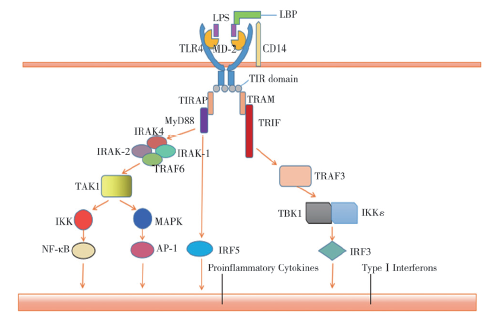
革兰阴性菌细胞壁外膜的脂多糖(LPS)是TLR4的特异性配体[11]。单纯转染TLR4不足以识别LPS,并且配体诱导的活化需要TLR4与细胞表面MD-2相结合[12]。MD-2与LPS相互作用,然后与TLR4的细胞外结构域非共价结合,形成TLR4/MD-2受体复合物[13]。LBP和CD14是增强LPS传感的辅助分子,LBP能够从聚集体中提取LPS单体并将其转移到CD14中,CD14受体通过膜结合形式结合单体LPS并将其转移到MD-2,促进六聚物复合物(TLR4/MD-2/LPS)2的形成,从而诱导含有TIR结构域的适配器蛋白的募集[14]。这些适配器通过TLR4细胞质尾部的TIR结构域与适配器上的TIR结构域之间的同质相互作用与TLR4簇相关联。
在LPS刺激下,MyD88依次募集并激活IL-1R受体相关激酶4(IRAK-4)、IRAK-1、TNF受体相关因子6(TRAF6)[15]。IRAK-4不仅负责招募、激活IRAK-1,还负责降解IRAK-1,IRAK-2也在LPS/TLR4信号传递中起作用[16,17]。TRAF6与泛素结合酶13(UBC13)、泛素结合酶E2变异体1异构体A(UEV1A)形成复合物,激活转化生长因子-β活化的蛋白激酶1(TAK1),然后TAK1激活下游IκB激酶(IKK)和丝裂原活化蛋白激酶(MAPK)通路。IKKα、IKKβ、IKKγ形成复合物催化IκB蛋白磷酸化,这种磷酸化导致IκB蛋白的降解和随后转录因子NF-κB的易位,进而引起IL-6、IL-12p40、TNF-α等多种炎症因子的表达[18]。下游MAPK途径的激活导致另一种转录因子AP-1的诱导,该因子在促炎细胞因子的表达中同样发挥了作用[19]。此外,IκBε和IFN调节因子5(IRF5)也是MyD88通路下游的2个重要因子。在LPS刺激下,缺乏IκBε的巨噬细胞对IL-6的表达有缺陷,而对TNF-α的表达正常。在IL-6的启动子区,IκBε可能与NF-κBp50亚基一起发挥作用[20]。以上就是TLR4的MyD88依赖通路,见图1
图1 MyD88依赖性通路和 MyD88独立(TRIF依赖)通路

2. MyD88独立(TRIF依赖)通路

该通路的激活发生在TLR4-MD2复合物内化后的内小体室。其激活涉及到TRIF相关适配器分子(TRAM)和含TIR结构域适配器诱导IFN-β(TRIF)的募集,TNF受体相关因子3(TRAF3)的激活,以及由TANK结合激酶1(TBK)和IKKε介导的IFN调节因子3(IRF3)核易位的诱导[21,22]。其中IRF3转录因子能够促进Ⅰ型IFN的产生,见图1

3. TLR4信号传导通路触发因素

除了识别外源性微生物PAMP外,TLR4还能识别内源性DAMP,TLR4的细胞内触发因素包括高迁移率族蛋白B1(HMGB1)和细胞热休克蛋白等,其中HMGB1与哮喘密切相关[23]。HMGB1是一种非组蛋白且普遍存在的染色体蛋白,在活性染色质中富集,是HMGB家族的一部分,由人的HMGB1基因(13q12)编码[24]。HMGB1可与TLR4结合激活NF-κB引起下游的炎症介质释放,有研究表明,阻断HMGB1活性能通过抑制气道炎症和调节肺成纤维细胞表型和激活来逆转气道重塑[25]

4.TLR4参与载脂蛋白E(APOE)信号通路

APOE的主要功能是促进受体介导的内吞和脂蛋白颗粒(例如极低密度脂蛋白和乳糜微粒)及胆固醇向细胞内的转运,此外APOE还具有促炎和抗炎作用,这取决于APOE的浓度。在鼠螨引起的哮喘小鼠模型中,APOE基因敲除小鼠表现出增强的气道反应性和杯状细胞增生[26]。与健康受试者及COPD患者相比,哮喘患者血浆中的APOE降低,IL-33升高[27]。研究证明高水平的APOE信号通过TLR4激活TAK1和IκKβ,IκKβ磷酸化NF-κB p65和TPL2,进而磷酸化c-Jun氨基末端激酶(JNK),从而诱导人哮喘小气道上皮细胞(SAEC) 分泌C-X-C基序趋化因子配体5 (CXCL5)促进气道炎症[28]

三、TLR4信号传导通路与哮喘发病机制

1. TLR4与“卫生假说”

Strachan提出了“卫生假说”,该假说提出儿童期减少接触传染性微生物会导致后期过敏性疾病风险增加。病原微生物能够促进免疫系统早期成熟,通过刺激1型辅助性T淋巴细胞(Th1)成熟,抑制Th2极化,最终降低IgE水平。相反,免疫成熟过程中的“干净”环境可能导致Th2持续存在。接触内毒素可能为“卫生假说”提供一种统一的机制。有研究表明,房屋灰尘和床垫灰尘中较高的内毒素水平与变态反应致敏和特应性哮喘的风险较低有关[29]。PRR识别内毒素,并通过由LPS、CD14、MD-2和TLR4形成的内毒素受体复合物激活先天免疫系统。这说明TLR4与“卫生假说”密切相关。

2. HMGB1与哮喘密切相关

HMGB1是一种高度保守的核蛋白,既可以由单核细胞、巨噬细胞和其他免疫细胞主动释放到细胞外,也可从受损的坏死组织细胞中被动释放,以促进多种炎症因子分泌[30]。此外,HMGB1还具有细胞外活性,即HMGB1能在内源性损伤相关分子模式中起作用,通过与晚期糖基化终产物受体(RAGE)和TLR相互作用,调节参与磷酸化和糖基化终产物合成的受体,这些受体导致某些细胞因子如TNF-α、IL-4和IL-6的增加[31]。研究表明HMGB1与RAGE、TLR2和TLR4的相互作用会激活MAPK和NF-κB的细胞内信号,引起促炎性细胞因子的激活和释放[32]

3. TLR4基因多态性与哮喘发生的风险

大量研究表明TLR2、TLR4和TLR9与哮喘或特应性疾病的发病机制有关[33]。TLR4多态性可以改变儿童的先天免疫反应,并可能是哮喘发展的重要决定因素。CD14通过促进LPS向TLR4的表达促进免疫激活,这会触发IL-12和IL-18的信号传导以及IFN产生。研究表明该反应受遗传控制,由Asp299Gly(核苷酸取代896A>G)组成的TLR4基因(染色体9q32-33)中的单核苷酸多态性(SNP)与吸入内毒素攻击的反应性低下,气道上皮中TLR4的密度降低以及炎症细胞因子对内毒素的反应减少有关[34]。这种多态性改变了受体对内毒素的反应,这是哮喘的重要诱因。
北美的研究者检测了TLR4在哮喘中的多态性,在研究中对TLR4基因进行了筛选,共发现了29个SNP[35]。TLR4 Asp299Gly等位基因与较高的革兰阴性菌感染发生率有关,这可能有助于特应性儿童哮喘的发展[36]。TLR4 Asp299Gly多态性还与儿童外周血单核细胞(PBMC)降低LPS诱导的IL-12(p70)和IL-10反应有关[37]。在携带TLR4 Asp299Gly等位基因的人群中,特应性疾病的严重性升高,这表明TLR4 Asp299Gly多态性导致先天免疫系统的反应降低,由此可见TLR4基因多态性与哮喘患者的特应性严重程度呈正相关[38]。除此之外,TLR2中的rs3804099和TLR4中的rs4986791也会导致罹患哮喘的风险增加[39]

4. 靶向TLR4及其信号通路治疗哮喘的价值

目前哮喘治疗的目的是尽量减少药物不良反应,并实现良好的哮喘控制,然而对于重症哮喘患者,目前还没有最佳治疗方法。免疫性疾病的抗免疫治疗已由广泛的抗炎治疗转为靶点治疗,TLR4及其信号通路为哮喘的治疗提供了多个新的潜在治疗靶点,如TLR4拮抗剂、抗LPS多肽、抗HMGB1抗体等。
将TLR4拮抗剂TAK-242注入卵清白蛋白(OVA)诱导的小鼠腹腔内发现,TAK-242能够降低小鼠鼻灌洗液中Th2细胞因子的水平,减少支气管肺泡灌洗液中的嗜酸性粒细胞和肺中Th2的数量[40]。沙格列汀是一种二肽基肽酶4抑制剂,已被广泛应用于治疗2型糖尿病。研究发现沙格列汀可以通过抑制TLR4/活性氧簇/NF-κB信号通路有效减轻OVA诱发哮喘小鼠的气道炎症,降低小鼠肺组织中的氧化应激以及NF-κB和TLR4的水平,这表明沙格列汀可能成为有效治疗急性过敏性哮喘的潜在药物[41]。白藜芦醇是存在于葡萄皮、浆果和坚果中的一种植物多酚物质[42]。白藜芦醇的有益作用已在肺纤维化、COPD、肺动脉高压和其他肺部疾病中得到证实[43,44]。有研究表明,大剂量的白藜芦醇通过抑制HMGB1/TLR4/NFκB途径释放的炎性细胞因子,减轻哮喘诱导的气道炎症和气道重塑,这为白藜芦醇作为潜在的新型哮喘治疗方法提供了证据[45]。丹皮酚降低了小鼠TLR4的表达和NFκB的核易位,以及哮喘模型中p38丝裂原活化蛋白激酶(p38 MAPK)和细胞外调节蛋白激酶(ERK)的磷酸化水平,通过抑制TLR4/NFκB和MAPK信号通路改善OVA诱导的哮喘[46]。抗HMGB1抗体能够减少邻苯二甲酸二异壬酯诱导的哮喘小鼠的Th2细胞因子、炎性细胞积累、黏蛋白产生,减轻气道高反应性及肺组织损伤[47]

四、结语

TLR4信号传导通路作为机体免疫功能的一部分,与炎症性和免疫性疾病的发生发展密不可分,在支气管哮喘的发生发展中起着重要的作用。TLR4信号传导通路存在多个治疗哮喘的潜在靶点,针对TLR4信号传导通路靶点的靶向治疗,为哮喘的治疗提供了一个新的研究方向,有着良好的研究前景。CC趋化因子受体5(CCR5)能够调控T细胞和单核细胞/巨噬细胞系的迁移、增殖与免疫功能,但其与TLR4信号传导通路的关系未见相关报道[48]。笔者课题组先前发现在哮喘小鼠体内应用CCR5第二胞外环的拮抗短肽能有效减轻哮喘小鼠肺组织的炎症程度,抑制TNF-α的表达[49]。TLR4信号传导通路的激活能引起TNF-α、 IL-4和IL-6等炎性细胞因子的释放,CCR5拮抗剂是否能够调控TLR4信号传导通路缓解哮喘炎症反应值得进一步探究。
[1]
Buelo A, McLean S, Julious S, Flores-Kim J, Bush A, Henderson J, Paton JY, Sheikh A, Shields M, Pinnock H. ARC Group. At-risk children with asthma (ARC): a systematic review. Thorax, 2018,73(9):813-824.

DOI PMID

[2]
Zhang Y, Jing Y, Qiao J, Luan B, Wang X, Wang L, Song Z. Activation of the mTOR signaling pathway is required for asthma onset. Sci Rep, 2017,7(1):4532.

DOI PMID

[3]
Lucas K, Maes M. Role of the toll like receptor (TLR) radical cycle in chronic inflammation: possible treatments targeting the TLR4 pathway. Mol Neurobiol, 2013,48(1):190-204.

DOI PMID

[4]
Lee HY, Rhee CK, Kang JY, Park CK, Lee SY, Kwon SS, Kim YK, Yoon HK. Effect of intranasal rosiglitazone on airway inflammation and remodeling in a murine model of chronic asthma. Korean J Intern Med, 2016,31(1):89-97.

DOI PMID

[5]
Crespo-Lessmann A, Mateus E, Vidal S, Ramos-Barbón D, Torrejón M, Giner J, Soto L, Juárez C, Plaza V. Expression of toll-like receptors 2 and 4 in subjects with asthma by total serum IgE level. Respir Res, 2016,17:41.

DOI PMID

[6]
Temperley ND, Berlin S, Paton IR, Griffin DK, Burt DW. Evolution of the chicken toll-like receptor gene family: a story of gene gain and gene loss. BMC Genomics, 2008,9:62.

[7]
Medzhitov R, Preston-Hurlburt P, Janeway CA Jr. A human homologue of the drosophila toll protein signals activation of adaptive immunity. Nature, 1997,388(6640):394-397.

DOI PMID

[8]
Ozato K, Tsujimura H Tamura T. Toll-like receptor signaling and regulation of cytokine gene expression in the immune system. Biotechniques, 2002, Suppl:66-68,70, 72.

DOI PMID

[9]
Aryan Z, Rezaei N. Toll-like receptors as targets for allergen immunotherapy. Curr Opin Allergy Clin Immunol, 2015,15(6):568-574.

DOI PMID

[10]
Lu YC, Yeh WC, Ohashi PS. LPS/TLR4 signal transduction pathway. Cytokine, 2008,42(2):145-151.

DOI PMID

[11]
Cochet F, Peri F. The role of carbohydrates in the lipopol-ysaccharide (lps)/toll-like receptor 4 (TLR4) signalling. Int J Mol Sci, 2017,18(11):2318.

[12]
Visintin A, Latz E, Monks BG, Espevik T, Golenbock DT. Lysines 128 and 132 enable lipopolysaccharide binding to MD-2, leading to toll-like receptor-4 aggregation and signal transduction. J Biol Chem, 2003,278(48):48313-48320.

DOI PMID

[13]
Ishihara S, Rumi MA, Kadowaki Y, Ortega-Cava CF, Yuki T, Yoshino N, Miyaoka Y, Kazumori H, Ishimura N, Amano Y, Kinoshita Y. Essential role of MD-2 in TLR4-dependent signaling during Helicobacter pylori-associated gastritis. J Immunol, 2004,173(2):1406-1416.

DOI PMID

[14]
Zanoni I, Ostuni R, Marek LR, Barresi S, Barbalat R, Barton GM, Granucci F, Kagan JC. CD14 controls the LPS-induced endocytosis of toll-like receptor 4. Cell, 2011,147(4):868-880.

DOI PMID

[15]
Wu TT, Tai YT, Cherng YG, Chen TG, Lin CJ, Chen TL, Chang HC, Chen RM. GATA-2 transduces LPS-induced IL-1β gene expression in macrophages via a toll-like receptor 4/MD88/MAPK-dependent mechanism. PLoS One, 2013,8(8):e72404.

[16]
De Nardo D, Balka KR, Cardona Gloria Y, Rao VR, Latz E, Masters SL. Interleukin-1 receptor-associated kinase 4 (IRAK4) plays a dual role in myddosome formation and toll-like receptor signaling. J Biol Chem, 2018,293(39):15195-15207.

DOI PMID

[17]
Strickson S, Emmerich CH, Goh ETH, Zhang J, Kelsall IR, Macartney T, Hastie CJ, Knebel A, Peggie M, Marchesi F, Arthur JSC, Cohen P. Roles of the TRAF6 and Pellino E3 ligases in MyD88 and RANKL signaling. Proc Natl Acad Sci U S A, 2017,114(17):E3481-E3489.

DOI PMID

[18]
Georg I, Díaz-Barreiro A, Morell M, Pey AL, Alarcón-Riquelme ME. BANK1 interacts with TRAF6 and MyD88 in innate immune signaling in B cells. Cell Mol Immunol, 2019, doi: 10.1038/s41423-019-0254-9. Epub ahead of print.

DOI PMID

[19]
Lv X, Wang H, Su A, Xu S, Chu Y. Herpes simplex virus type 2 infection triggers AP-1 transcription activity through TLR4 signaling in genital epithelial cells. Virol J, 2018,15(1):173.

DOI PMID

[20]
Scheibel M, Klein B, Merkle H, Schulz M, Fritsch R, Greten FR, Arkan MC, Schneider G, Schmid RM. IkappaBbeta is an essential co-activator for LPS-induced IL-1beta transcription in vivo. J Exp Med, 2010,207(12):2621-2630.

DOI PMID

[21]
Shalaby KH, Al Heialy S, Tsuchiya K, Farahnak S, McGovern TK, Risse PA, Suh WK, Qureshi ST, Martin JG. The TLR4-TRIF pathway can protect against the development of experimental allergic asthma. Immunology, 2017,152(1):138-149.

DOI PMID

[22]
Cheng Z, Taylor B, Ourthiague DR, Hoffmann A. istinct single-cell signaling characteristics are conferred by the MyD88 and TRIF pathways during TLR4 activation. Sci Signal, 2015, 8(385):ra69.

DOI PMID

[23]
Land WG. The role of damage-associated molecular patterns in human diseases: part I - promoting inflammation and immunity. Sultan Qaboos Univ Med J, 2015,15(1):e9-e21.

PMID

[24]
Imbalzano E, Quartuccio S, Di Salvo E, Crea T, Casciaro M, Gangemi S. Association between HMGB1 and asthma: a litera-ture review. Clin Mol Allergy, 2017,15:12.

DOI PMID

[25]
Hou C, Kong J, Liang Y, Huang H, Wen H, Zheng X, Wu L, Chen Y. HMGB1 contributes to allergen-induced airway remodeling in a murine model of chronic asthma by modulating airway inflammation and activating lung fibroblasts. Cell Mol Immunol, 2015,12(4):409-423.

DOI PMID

[26]
Yao X, Fredriksson K, Yu ZX, Xu X, Raghavachari N, Keeran KJ, Zywicke GJ, Kwak M, Amar MJ, Remaley AT, Levine SJ. Apolipoprotein E negatively regulates house dust mite-induced asthma via a low-density lipoprotein receptor-mediated pathway. Am J Respir Crit Care Med, 2010,182(10):1228-1238.

DOI PMID

[27]
Bhowmik M, Majumdar S, Dasgupta A, Gupta Bhattacharya S, Saha S. Pilot-scale study of human plasma proteomics identifies ApoE and IL33 as markers in atopic asthma. J Asthma Allergy, 2019,12:273-283.

DOI PMID

[28]
Kalchiem-Dekel O, Yao X, Barochia AV, Kaler M, Figueroa DM, Karkowsky WB, Gordon EM, Gao M, Fergusson MM, Qu X, Liu P, Li Y, Seifuddin F, Pirooznia M, Levine SJ. Apolipoprotein E signals via TLR4 to induce CXCL5 secretion by asthmatic airway epithelial cells. Am J Respir Cell Mol Biol, 2020 Apr 27. doi: 10.1165/rcmb.2019-0209OC. Epub ahead of print.

DOI PMID

[29]
von Mutius E. Environmental factors influencing the development and progression of pediatric asthma. J Allergy Clin Immunol, 2002,109(6 Suppl):S525-S532.

PMID

[30]
Cavone L, Cuppari C, Manti S, Grasso L, Arrigo T, Calamai L, Salpietro C, Chiarugi A. Increase in the level of proinflammatory cytokine HMGB1 in nasal fluids of patients with rhinitis and its sequestration by glycyrrhizin induces eosinophil cell death. Clin Exp Otorhinolaryngol, 2015,8(2):123-128.

DOI PMID

[31]
Lotze MT, Tracey KJ. High-mobility group box 1 protein (HMGB1): nuclear weapon in the immune arsenal. Nat Rev Immunol, 2005,5(4):331-342.

PMID

[32]
Huang LF, Yao YM, Sheng ZY. Novel insights for high mobility group box 1 protein-mediated cellular immune response in sepsis: a systemic review. World J Emerg Med, 2012,3(3):165-171.

DOI PMID

[33]
Martinez FD, Vercelli D. Asthma. Lancet, 2013,382(9901):1360-1372.

[34]
Arbour NC, Lorenz E, Schutte BC, Zabner J, Kline JN, Jones M, Frees K, Watt JL, Schwartz DA. TLR4 mutations are associated with endotoxin hyporesponsiveness in humans. Nat Genet, 2000,25(2):187-191.

DOI PMID

[35]
Raby BA, Klimecki WT, Laprise C, Renaud Y, Faith J, Lemire M, Greenwood C, Weiland KM, Lange C, Palmer LJ, Lazarus R, Vercelli D, Kwiatkowski DJ, Silverman EK, Martinez FD, Hudson TJ, Weiss ST. Polymorphisms in toll-like receptor 4 are not associated with asthma or atopy-related phenotypes. Am J Respir Crit Care Med, 2002,166(11):1449-1456.

DOI PMID

[36]
Lorenz E, Mira JP, Frees KL, Schwartz DA. Relevance of mutations in the TLR4 receptor in patients with gram-negative septic shock. Arch Intern Med, 2002,162(9):1028-1032.

[37]
Fagerås Böttcher M, Hmani-Aifa M, Lindström A, Jenmalm MC, Mai XM, Nilsson L, Zdolsek HA, Björkstén B, Söderkvist P, Vaarala O. A TLR4 polymorphism is associated with asthma and reduced lipopolysaccharide-induced interleukin-12(p70) responses in Swedish children. J Allergy Clin Immunol, 2004,114(3):561-567.

[38]
Yang IA, Barton SJ, Rorke S, Cakebread JA, Keith TP, Clough JB, Holgate ST, Holloway JW. Toll-like receptor 4 polymorphism and severity of atopy in asthmatics. Genes Immun, 2004,5(1):41-45.

DOI PMID

[39]
Zhao J, Shang H, Cao X, Huang Y, Fang X, Zhang S, Xie M, Xie J, Liu X. Association of polymorphisms in TLR2 and TLR4 with asthma risk: an update meta-analysis. Medicine (Baltimore), 2017,96(35):e7909.

[40]
Tang H, Li T, Han X, Sun J. TLR4 antagonist ameliorates combined allergic rhinitis and asthma syndrome (CARAS) by reducing inflammatory monocytes infiltration in mice model. Int Immunopharmacol, 2019,73:254-260.

DOI PMID

[41]
Helal MG, Megahed NA, Abd Elhameed AG. Saxagliptin mitigates airway inflammation in a mouse model of acute asthma via modulation of NF-kB and TLR4. Life Sci, 2019,239:117017.

DOI PMID

[42]
Yadav M, Jain S, Bhardwaj A, Nagpal R, Puniya M, Tomar R, Singh V, Parkash O, Prasad GB, Marotta F, Yadav H. Biological and medicinal properties of grapes and their bioactive constituents: an update. J Med Food, 2009,12(3):473-484.

DOI PMID

[43]
Wang J, He F, Chen L, Li Q, Jin S, Zheng H, Lin J, Zhang H, Ma S, Mei J, Yu J. Resveratrol inhibits pulmonary fibrosis by regulating miR-21 through MAPK/AP-1 pathways. Biomed Pharmacother, 2018,105:37-44.

DOI PMID

[44]
Wang XL, Li T, Li JH, Miao SY, Xiao XZ. The effects of resveratrol on inflammation and oxidative stress in a rat model of chronic obstructive pulmonary disease. Molecules, 2017,22(9):1529.

[45]
Jiang H, Duan J, Xu K, Zhang W. Resveratrol protects against asthma-induced airway inflammation and remodeling by inhibiting the HMGB1/TLR4/NF-κB pathway. Exp Ther Med, 2019,18(1):459-466.

DOI PMID

[46]
Tang Y, Huang W, Song Q, Zheng X, He R, Liu J. Paeonol ameliorates ovalbumin-induced asthma through the inhibition of TLR4/NF-κB and MAPK signaling. Evid Based Complement Alternat Med, 2018,2018:3063145.

DOI PMID

[47]
Hwang YH, Lee Y, Paik MJ, Yee ST. Inhibitions of HMGB1 and TLR4 alleviate DINP-induced asthma in mice. Toxicol Res (Camb), 2019,8(5):621-629.

[48]
梁蓉蓉, 黄花荣. CCR5与支气管哮喘免疫学发病机制研究进展. 新医学, 2016,47(1):12-16.

[49]
梁蓉蓉, 李雯静, 刘娟, 沈溪明, 黄花荣. CCR5第二胞外环的拮抗短肽对哮喘小鼠肺组织炎症细胞浸润和TNF-α表达的影响. 中国病理生理杂志, 2017,33(4):596-602.

Outlines

/