Original Research

Effect of glandular involvement and HPV infection on the recurrence of high-grade squamous intraepithelial lesions of the cervix

  • Wu Chenpeng ,
  • Li Xiaohua ,
  • Li Xuemei ,
  • Fan Zhibin ,
  • Li Jun ,
  • Zhang Zhiyong
Expand
  • Department of Pathology, Tangshan Gongren Hospital, Tangshan 063000, China
Zhang Zhiyong,E-mail:

Received date: 2022-09-01

  Online published: 2023-06-08

Abstract

Objective To evaluate the effect of glandular involvement and persistent human papillomavirus(HPV) infection upon the recurrence of high-grade squamous intraepithelial lesion(HSIL) of the cervix, aiming to provide evidence for postoperative clinical management. Methods Clinical data of 596 HSIL patients who underwent cold-knife conization were collected, including 240 cases of glandular involvement(glandular involvement group) and 356 cases of non-glandular involvement(non-glandular involvement group). The recurrence of HSIL at postoperative 2 years was considered as the end point. The differences between recurrent and non-recurrent patients were compared. According to glandular involvement and HPV-16 infection, patients were divided into the glandular involvement+HPV-16 infection, glandular involvement alone, HPV-16 infection alone and non-glandular involvement+non-HPV-16 infection groups, respectively. The differences in the recurrence rate of HSIL were compared among four groups. Results Among 596 HSIL patients, 75 cases recurred(12.6%). HPV-16 infection rate in the glandular involvement group was 67.9%, significantly higher than 23.0% in the non-glandular involvement group, and the difference was statistically significant(P < 0.05). In univariate analysis, the proportion of≥45 years old, glandular involvement and persistent HPV-16 infection were not significantly correlated with the recurrence of HSIL(all P > 0.05). The recurrence rates of HSIL were 33.8%, 10.9%, 8.5% and 9.7% in the glandular involvement+HPV-16 infection, glandular involvement alone, HPV-16 infection alone and non-glandular involvement+non-HPV-16 infection groups, respectively. The recurrence rate of HSIL in patients with glandular involvement+HPV-16 infection was significantly higher than that in other three groups, and the difference was statistically significant(all P < 0.017). Conclusions HSIL patients with glandular involvement and persistent HPV-16 infection are prone to relapse after cervical cold-knife conization. For these patients, active surgical regimen should be adopted and postoperative follow-up should be strengthened.

Cite this article

Wu Chenpeng , Li Xiaohua , Li Xuemei , Fan Zhibin , Li Jun , Zhang Zhiyong . Effect of glandular involvement and HPV infection on the recurrence of high-grade squamous intraepithelial lesions of the cervix[J]. JOURNAL OF NEW MEDICINE, 2023 , 54(5) : 354 -358 . DOI: 10.3969/j.issn.0253-9802.2023.05.010

宫颈高级别鳞状上皮内病变(HSIL)是宫颈癌的前驱病变,除非治疗得当,否则可能进展为宫颈癌[1]。HSIL病变的推荐治疗方法是锥切术,然后进行常规的人乳头瘤病毒(HPV)和(或)宫颈细胞学检查[2]。宫颈锥切术后复发危险因素包括切缘阳性、高危型HPV感染、腺体受累及年龄等[3-6]。其中切缘阳性是最重要的复发危险因素,无生育要求者可以考虑再次手术治疗[7]。与切缘阳性不同,对腺体受累及HPV持续感染患者临床处理存在争议,该2项因素在HSIL中的临床意义尚未得到广泛认可,结合腺体受累及HPV感染分析其对HSIL复发的影响鲜有报道。本研究根据宫颈腺体受累和HPV感染情况对接受宫颈冷刀锥切术治疗的HSIL患者进行了临床预后研究,评估两者对HSIL患者临床病程的影响。

对象与方法

一、研究对象

2016年1月至2020年6月在唐山市工人医院及唐山市妇幼保健院行宫颈冷刀锥切术治疗的HSIL患者共596例,其中腺体受累240例、腺体未受累356例。本研究为回顾性研究,样本量功效大于80%,样本量可保证研究结论具有一定可靠性。纳入标准:①经组织病理诊断为HSIL;②术后每6个月复查HPV和(或)进行宫颈脱落细胞检测;③可获取患者完整的临床病理资料及随访资料。排除标准:①曾行其他宫颈手术治疗;②哺乳期及妊娠期女性;③合并其他恶性肿瘤;④切缘阳性者。本研究已通过唐山市工人医院伦理委员会审查(伦理批件号:GRYY-LL-2019-27)。

二、研究方法

宫颈HPV筛查采用美国罗氏公司的Cobas 4800检测平台进行检测,本检测方法共检测14种高危型HPV(包括HPV-16、HPV-18、HPV-26、HPV-31、HPV-33、HPV-35、HPV-39、HPV-45、HPV-52、HPV-56、HPV-58、HPV-59、HPV-66、HPV-68),并对HPV-16和HPV-18单独分型检测,所有操作均严格按照厂家说明书进行。宫颈冷刀锥切术用卢戈氏碘液显示碘不着色区,沿不着色区域外缘3~5 mm进行切除,锥高切除范围1.5~2.5 cm。宫颈组织病理诊断由一名医师初诊,然后再由一名副主任医师复诊,诊断标准参考2020年第5版子宫颈肿瘤WHO分类。

三、研究流程

596例患者术前均进行HPV检测,宫颈冷刀锥切术后病理诊断为HSIL,每6个月复查HPV和(或)进行宫颈脱落细胞检测,以随访2年或再次出现HSIL为研究终点,末次随访时间为2022年7月。腺体受累被定义为宫颈腺体结构中出现HSIL,同种型别HPV感染1年及以上判定为持续感染,术后6个月以上再次出现HSIL判定为复发。分析腺体受累和HPV感染对复发的影响。

四、统计学处理

采用SPSS 26.0处理数据。计数资料以例(%)表示,组间比较采用χ2检验。2组间比较P < 0.05为差异有统计学意义。本研究主要关注腺体受累伴HPV-16持续感染患者与腺体受累不伴HPV-16持续感染患者、腺体不受累伴HPV-16持续感染患者和腺体不受累不伴HPV-16持续感染患者间的复发率间差异,故对腺体受累伴HPV-16持续感染组与其他3组间的复发率比较采用Bonferroni法校正,即P < 0.05/3 = 0.017为差异有统计学意义。

结果

一、临床病理资料

HPV-16阳性245例,其中112例为HPV-16持续感染;HPV-18阳性63例,其中HPV-18型持续感染9例;HPV其他12型阳性248例,其中HPV其他12型持续感染35例;HPV阴性40例。随访结束时,复发75例、未复发521例。

二、腺体受累组与腺体未受累组患者的不同型别HPV初次感染情况比较

腺体受累组患者的HPV-16感染率高于腺体未受累组(P < 0.05),HPV-18型及其他12型感染率在腺体受累组与腺体未受累组间比较差异无统计学意义(P均> 0.05)。见表1
表1 腺体受累组与腺体未受累组患者的不同型别HPV初次感染情况比较[例(%)]
组 别 例数 HPV-16 HPV-18 HPV其他12型
腺体受累组 240 163(67.9) 30(12.5) 102(42.5)
腺体未受累组 356 82(23.0) 33(9.3) 146(41.0)
χ2 119.288 1.582 0.131
P值 <0.001 0.208 0.718

三、复发组与未复发组患者的年龄、腺体受累率、HPV-16持续感染情况比较

复发组与未复发组患者的 ≥ 45岁者比例、腺体受累率、HPV-16持续感染率比较差异均无统计学意义(P均> 0.05)。见表2
表2 复发组与未复发组患者的年龄、腺体受累、HPV持续感染率比较 [例(%)]
组 别 例数 年龄≥45岁 腺体受累 HPV-16持续感染
复发组 75 41(54.7) 36(48.0) 20(26.7)
未复发组 521 233(44.7) 204(39.2) 92(17.7)
χ2 2.611 2.132 3.486
P值 0.106 0.144 0.062

四、腺体受累联合HPV-16持续感染对宫颈锥切术后复发的影响

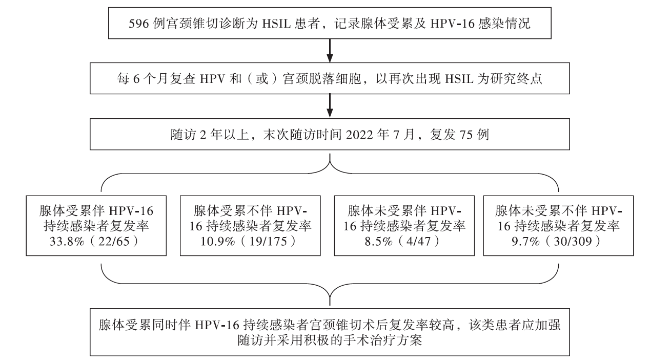
根据腺体受累联合HPV-16持续感染情况将患者分为腺体受累伴HPV-16持续感染组、腺体受累不伴HPV-16持续感染组、腺体不受累伴HPV-16持续感染组和腺体不受累不伴HPV-16持续感染组,其复发率分别为33.8%、10.9%、8.5%和9.7%。腺体受累伴HPV-16持续感染患者的复发率高于其他3组,组间比较差异均有统计学意义(χ2 = 17.683,P < 0.001;χ2 = 9.822,P = 0.002;χ2 = 26.138,P < 0.001)。研究分析流程详见图1
图1 腺体受累联合HPV-16持续感染对宫颈锥切术后复发影响分析流程

讨论

宫颈癌在我国的发病率和病死率居高不下, 2020年我国宫颈癌死亡病例5.3万,占全世界的15.5%,宫颈癌新增病例11万,占全世界的18.2%[8]。降低宫颈癌的患病率和病死率的其中一种有效方法是早期检测和治疗HSIL。HSIL是一种癌前病变,在癌前病变期间给予适当的治疗可有效预防宫颈癌的发生。宫颈锥形切除术是诊断和治疗HSIL的最佳方法。影响HSIL宫颈锥切术后复发的因素众多,包括切缘阳性、腺体受累、高危型HPV感染及患者年龄等[3-6]。其中切缘阳性对复发影响的研究结果较为一致,但有关腺体受累和HPV感染的研究结果不尽相同。本研究选切缘阴性的HSIL患者作为研究对象,重点探讨腺体受累和HPV感染对锥切术后复发的影响。
宫颈HSIL腺体受累被定义为先前存在的腺体结构中存在HSIL。宫颈脱落细胞学诊断HSIL腺体受累的灵敏度及诊断一致性较差,腺体受累的确诊要依靠组织学检查结果[9]。腺体受累对HSIL患者预后影响及临床处理的研究结果并不一致。部分研究指出,腺体受累与宫颈锥切术后复发密切相关,且平均复发时间更短,该类患者可增加锥切深度并应加强随访[10-11]。但是,Kim等[12]发现腺体受累患者和腺体未受累患者的HSIL复发率比较差异无统计学意义,但在腺体受累患者中进行额外的手术治疗更为频繁,应仔细考虑基于腺体受累的再次手术,以避免过度治疗和手术并发症。刘慧慧[13]的研究也显示腺体受累与复发无关。
HPV是引致HSIL的主要病原体,接受HSIL治疗患者的HPV总体感染率为84.9%~98.5%,锥切治疗不能完全根除HPV感染[14]。HPV-16比其他HPV型别的致病力更强且不易被清除[15]。与腺体受累类似,HPV感染对HSIL复发的影响也存在争议。多项研究显示,持续性 HPV感染易导致HSIL复发,是复发的独立预测因素,尤其是HPV- 16的持续感染[16-17]。但另有研究表明宫颈HPV感染与HSIL复发无关[11,18]
上述研究仅对腺体受累和HPV感染情况进行单独分析,研究结论存在差异。本研究显示,596例HSIL患者中,HPV-16阳性者最多,而腺体受累患者中的HPV-16感染者比例高于腺体未受累者。虽然复发组与未复发组患者的 ≥ 45岁者比例、腺体受累率、HPV-16持续感染率比较差异均无统计学意义,但进一步对腺体受累和HPV-16持续感染的联合分析显示,腺体受累伴HPV-16持续感染患者的复发率高于其他患者。因此,联合分析腺体受累及HPV-16持续感染情况,对于锥切术后的预后评估及临床处理可能具有重要意义。
综上所述,腺体受累和HPV-16持续感染作为单一因素对HSIL复发的影响尚存在争议,腺体受累与HPV-16感染密切相关,联合分析HSIL患者的腺体受累及HPV-16持续感染情况至关重要,腺体受累同时伴HPV-16持续感染的患者复发率高于其他患者,对于该类患者应考虑采取更积极的随访及治疗方案。
[1]
Abdulaziz A M A, You X, Liu L, et al. Management of high-grade squamous intraepithelial lesion patients with positive margin after LEEP conization: a retrospective study. Medicine, 2021, 100(20): e26030.

DOI

[2]
Perkins R B, Guido R S, Castle P E, et al. Erratum: 2019 ASCCP risk-based management consensus guidelines for abnormal cervical cancer screening tests and cancer precursors. J Low Genit Tract Dis, 2021, 25(4): 330-331.

DOI

[3]
Andersson S, Megyessi D, Belkić K, et al. Age, margin status, high-risk human papillomavirus and cytology independently predict recurrent high-grade cervical intraepithelial neoplasia up to 6 years after treatment. Oncol Lett, 2021, 22(3): 684.

DOI PMID

[4]
Khunnarong J, Bunyasontikul N, Tangjitgamol S. Treatment outcomes of patients with cervical intraepithelial neoplasia or invasive carcinoma who underwent loop electrosurgical excision procedure. World J Oncol, 2021, 12(4): 111-118.

DOI PMID

[5]
Feng H, Chen H, Huang D, et al. Relationship between positive margin and residual/recurrence after excision of cervical intraepithelial neoplasia: a systematic review and meta-analysis. Transl Cancer Res, 2022, 11(6): 1762-1769.

DOI PMID

[6]
Bogani G, Pinelli C, Chiappa V, et al. Age-specific predictors of cervical dysplasia recurrence after primary conization: analysis of 3, 212 women. J Gynecol Oncol, 2020, 31(5): e60.

DOI

[7]
Wang X, Xu J, Gao Y, et al. Necessity for subsequent surgery in women of child-bearing age with positive margins after conization. BMC Women's Health, 2021, 21(1): 191.

DOI

[8]
Sung H, Ferlay J, Siegel R L, et al. Global cancer statistics 2020: GLOBOCAN estimates of incidence and mortality worldwide for 36 cancers in 185 countries. CA A Cancer J Clin, 2021, 71(3): 209-249.

DOI

[9]
Jones R, Dale F, Fite J, et al. Endocervical glandular involvement is associated with an increased detection rate of high-grade squamous intraepithelial lesions on the Papanicolaou test. J Am Soc Cytopathol, 2020, 9(3): 137-145.

DOI PMID

[10]
Kodama K, Yahata H, Okugawa K, et al. Prognostic outcomes and risk factors for recurrence after laser vaporization for cervical intraepithelial neoplasia: a single-center retrospective study. Int J Clin Oncol, 2021, 26(4): 770-776.

DOI PMID

[11]
芦恩婷, 邓雷, 曾庆东, 等. 冷刀锥切术后宫颈高级别上皮内瘤变复发的影响因素. 中国医科大学学报, 2021, 50(6): 526-529, 534.

[12]
Kim N R, Baek Z H, Lee A J, et al. Clinical outcomes associated with endocervical glandular involvement in patients with cervical intraepithelial neoplasia III. J Clin Med, 2022, 11(11): 2996.

DOI

[13]
刘慧慧. 高级别宫颈鳞状上皮内病变患者宫颈锥切术后复发的预测因素分析. 航空航天医学杂志, 2022, 33(2): 138-140.

[14]
Huang H J, Tung H J, Yang L Y, et al. Role of human papillomavirus status after conization for high-grade cervical intraepithelial neoplasia. Int J Cancer, 2021, 148(3): 665-672.

DOI

[15]
臧乐靖, 胡燕. HSIL患者子宫颈锥切术后HPV持续感染相关因素研究现状. 新医学, 2021, 52(4): 239-242.

DOI

[16]
Bruno M T, Cassaro N, Garofalo S, et al. HPV16 persistent infection and recurrent disease after LEEP. Virol J, 2019, 16(1): 148.

DOI PMID

[17]
Ouh Y T, Cho H W, Kim S M, et al. Risk factors for type-specific persistence of high-risk human papillomavirus and residual/recurrent cervical intraepithelial neoplasia after surgical treatment. Obstet Gynecol Sci, 2020, 63(5): 631-642.

DOI

[18]
唐奕仕. 育龄期宫颈HSIL初次锥切术后病灶复发相关因素分析. 广州: 广州医科大学, 2021: 23.

Outlines

/